

Most light bulbs, heat lamps & some heat mats can sometimes lead to your snake being burned.
Please ensure all heat & light bulbs are covered by a wire safety cage, and that your reptarium's heating is controlled by
a suitable thermostat.

Anti-bacterial hand gel is great for sanitising your hands when handling your snakes, but make sure the gel is thoroughly dried in before feeding or handling any type of reptile.
Online Help & Advice For Corn Snake Owners


The Corn Snakes Natural Habitat
Corn snakes are found in the eastern United States, from southern New Jersey south through Florida, west into Louisiana and parts of Kentucky, however, corn snakes are most abundant in Florida and the south-eastern United States. Corn snakes are often found in woodlands, meadowlands and rocky hillsides. Abandoned buildings and barns are often inhabited by mice and other small rodents, so these are also favourite habitats for corn snakes, due to the plentiful food supply.
The Corn Snakes Natural Diet
Adult corn snakes do not normally feed daily, instead they tend to eat one large meal every week or so, unless they are moulting (shedding their skin) or gravid (carrying embryos or eggs). In the wild, adult corn snakes feed on mice, young rats, birds and bats, while hatchling & young corn snakes feed on small lizards and tree frogs.
The Corn Snakes Diet In Captivity
In captivity, corn snakes are fed mainly on mice, rat pups and chicks. As with most other species of snake, the corn snake will eat food of a proportional size to them selves, so an adult corn snake will eat adult mice & small rats, while a baby corn snake will eat baby mice, known as 'pinkies'.
How Corn Snakes Feed
Corn snakes are constrictors and they feed by biting their prey in order to obtain a firm grip, and then quickly wrapping one or more coils of their body around the prey in order to suffocate the prey before eating it. The corn snake will then usually move their head to the head of their prey and swallow the food whole, corn snakes rarely eat their meal feet first. If the corn snake's prey is relatively small, the snake may decide to strike at the prey and swallow it alive.
Status Of The Corn Snake
Corn snakes are not an endangered species, however, they are listed by the state of Florida as a Species of Special Concern because they face habitat loss and destruction in the lower Florida Keys. Corn snakes are often killed in error where they have been mistaken for venomous copperhead snakes.
Corn snakes are a very popular breed of snake due to their pleasant nature and ease to keep and they are frequently bred for pet purposes, however, they are also sometimes captured in the wild to be sold as pets.
Corn snakes are one of the more appreciated species of snake because they help to control rodent populations that may otherwise spread disease.
Lifespan Of A Corn Snake
Corn snakes in captivity will generally have a lifespan of around 20 - 25 Years. This is achieved by feeding on disease free rodents which have been bred for the purpose, having access to a constant clean water supply, receiving TLC from their keepers when they are shedding or gravid, and not having any predators to worry about !
Wild corn snakes are not so fortunate, feeding on prey which could be diseased, drinking pond water alive with bacteria, and the stress of fighting or escaping from predators will inevitably shorten their life, but the corn snake is a fairly tough species of snake, and they are still likely to live for 10 - 20 Years in the wild.

We now have some baby corn snakes for sale.
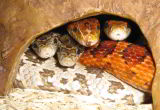
These are four of our corns watching us, watching them!
We are looking for all types of snake photos for our snake gallery pages.
Please email us your own original snake photos with your name and a little info about your pet.